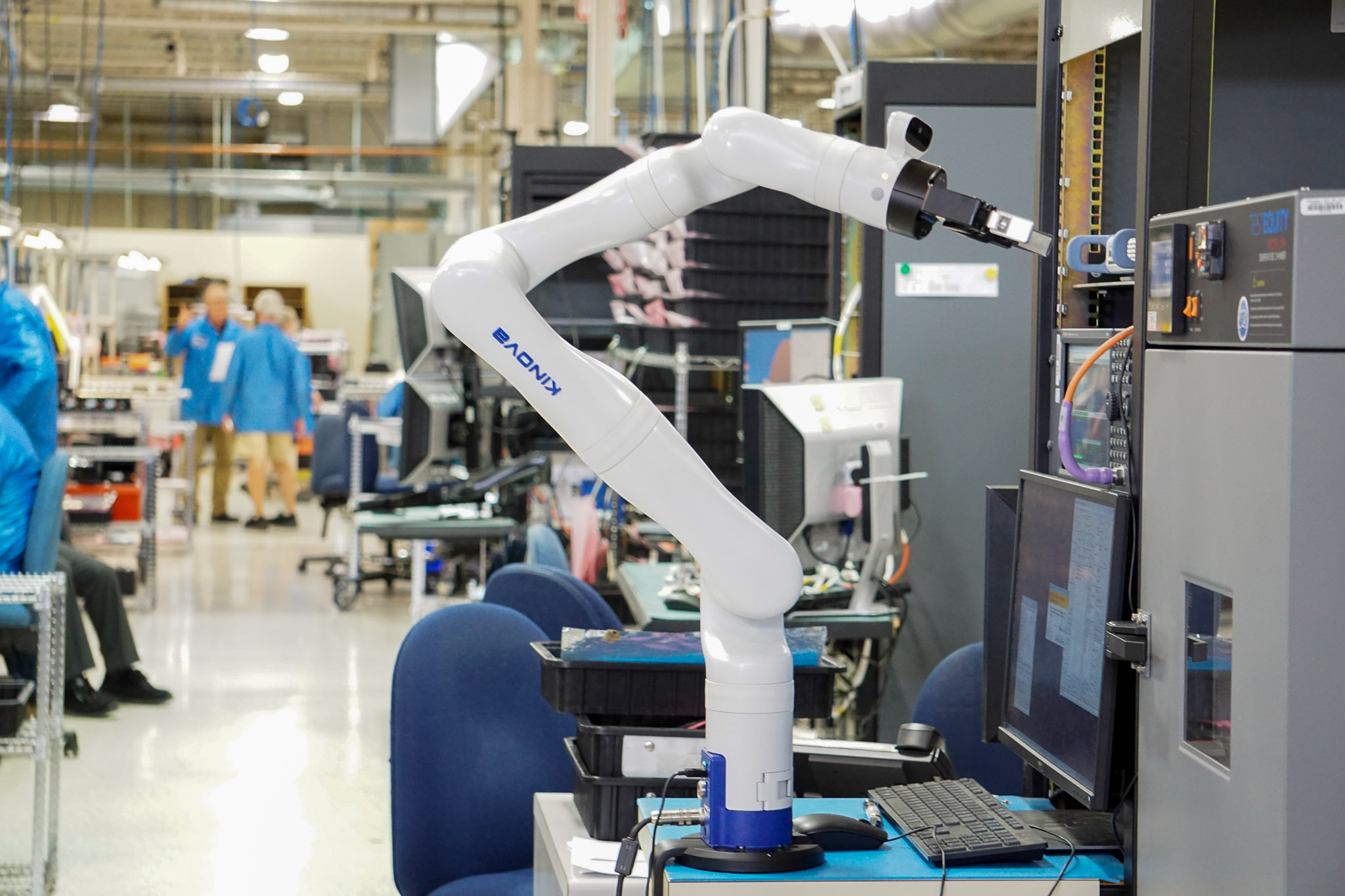
For 20 years, Kinova has been designing and manufacturing robotic technologies in Canada with a singular vision: building robotics that work seamlessly alongside people.
Founded in 2006 in Boisbriand, Québec, Kinova began with a deeply human
mission – helping individuals living with mobility limitations regain independence through robotics. What started as an assistive robotics innovation has since evolved into a globally recognized Canadian robotics company serving researchers, healthcare innovators, medical device manufacturers, and technology leaders across more than 40 countries.
Today, Kinova robots are used in advanced research laboratories, embedded in next-generation medical technologies, integrated into Physical AI applications, and deployed in highly demanding environments where precision, safety, and reliability are critical.
What continues to define Kinova is not only what we build – but how we build it.
Every Kinova robotic platform is engineered, assembled, and tested in Canada by multidisciplinary teams dedicated to the highest manufacturing and quality standards.
By maintaining close integration between R&D, software, manufacturing, testing, and customer support, we ensure exceptional control over performance, reliability, and product evolution.
Our Canadian manufacturing approach allows us to remain agile, collaborative, and innovation-driven while supporting industries where precision matters most – including medical robotics, assistive technologies, advanced research, and automation.

Over the last two decades, Kinova has become one of the most widely adopted robotic arm platforms in robotics research and innovation ecosystems worldwide. Yet despite our global reach, we remain proudly rooted in Quebec, where our culture continues to reflect the values that shaped us from the beginning: ingenuity, collaboration, humanity, and long-term partnership.
As robotics enters a new era driven by AI, human-machine collaboration, and clinical innovation, Kinova continues to push forward with the same ambition that inspired its founding more than 20 years ago: creating robotics purpose-built for real human environments – not adapted from industrial ones.